
Many privacy-minded users assume that installing a privacy-focused mobile wallet is enough to make their cryptocurrency activity private. That shortcut is seductive: download, set PIN, send XMR, breathe easy. The reality is messier because privacy is an emergent property of hardware, protocol choices, networking, key custody, and user behavior. A secure mobile wallet like Cake Wallet bundles many strong mechanisms — device-level encryption, Tor/I2P networking, Monero subaddresses, Litecoin MWEB, PayJoin for Bitcoin, and open-source non-custodial architecture — but each mechanism has limits and dependencies. Understanding those layers turns a passive assumption into an active security posture you can reason about and improve.
This article teases apart how exchange-in-wallet features, multi-currency design, and network privacy interact; it corrects common misconceptions; and it gives concrete heuristics for US-based privacy-conscious users who want Monero, Bitcoin, Litecoin and other currencies on mobile without surrendering control or introducing avoidable leaks.
How mobile privacy wallets actually build privacy: mechanisms, not slogans
Start with anatomy. A privacy-conscious wallet stacks capabilities across three domains: secrecy of keys (local custody and hardware protections), transaction privacy (protocol-level options), and network anonymity (how your device talks to nodes and peers). Cake Wallet ties these together in concrete ways that matter:
– Key custody: non-custodial by design; private keys never leave the device. Device-level encryption uses Secure Enclave on iOS or TPM features on Android, and access is gated by a short PIN and biometrics. That reduces risk from remote server compromise but does not eliminate local threats such as device compromise or malware.
– Transaction privacy: for Monero, the wallet uses subaddresses and ensures the private view key never leaves the device; for Bitcoin, it supports Silent Payments, PayJoin v2, UTXO coin control, and batching; for Litecoin, optional MWEB (MimbleWimble Extension Blocks) adds a privacy layer; Zcash outgoing transactions are mandatorily shielded to prevent transparent-address leaks.
– Network privacy: Tor-only mode, I2P proxy support, and custom node connections let users decouple IP addresses from transaction broadcasts. Combined with a strict zero-telemetry policy, that reduces metadata leakage to the developers themselves. But network protections are only effective when configured and when endpoints (nodes, market makers) respect privacy.
Exchange-in-wallet and multi-currency: convenience, routing mechanics, and privacy implications
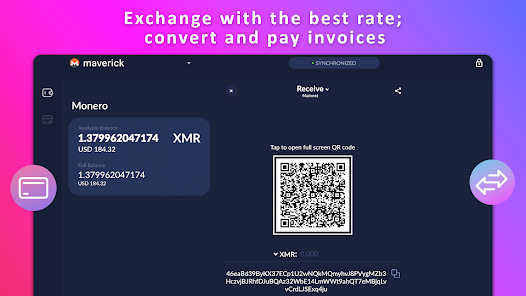
In-wallet swapping is a convenience many users value, but it adds a layer of economic and network interactions that change privacy calculus. Cake Wallet’s built-in exchange uses NEAR Intents to route cross-chain swaps via decentralized matching among market makers. Mechanically this means your request is routed, offers are aggregated, and settlement paths are found without a single central exchange holding custody.
This architecture reduces custodial counterparty risk compared to a centralized exchange, and NEAR Intents can find competitive rates by routing across multiple liquidity providers. However, decentralized routing still involves communicating swap intents to market makers and potentially routing through on-chain steps that carry metadata. The privacy gain from using Monero, MWEB for Litecoin, or shielded Zcash on the receiving side can be partially offset if routing steps are observable or if intermediary market makers keep logs. The wallet’s zero-data-collection policy and Tor/I2P options mitigate this, but they cannot change counterparty practices outside the device.
Practical implication: prefer peer routes that preserve native privacy primitives (for example, swap into Monero rather than layering through several BTC UTXO hops) and use custom node connections and Tor when initiating swaps you want to keep unlinkable. If you require maximum separation, perform cross-chain transfers using an air-gapped hardware flow (Cake’s Cupcake or Ledger integration) combined with manual relay through privacy-preserving endpoints.
Common myths, corrected
Myth: “If my wallet is open-source and non-custodial, I have full privacy automatically.” Correction: Open-source and non-custodial are necessary but not sufficient. Source transparency verifies what the app does, but privacy depends on runtime behavior: which nodes you use, whether you enable Tor, and how swaps are routed. Also, the device environment (OS updates, malware) can undermine privacy even when the wallet itself is well-implemented.
Myth: “Using MWEB or shielded ZEC is always private.” Correction: MWEB and ZEC shielding improve on-chain confidentiality, but privacy depends on adoption and linking patterns. Mandatory shielding on Zcash for outgoing transactions reduces a particular class of leaks, but incoming or intermediate steps and off-chain agreements (like KYC at swap endpoints) can reintroduce linkability.
Myth: “Hardware wallets remove all risk.” Correction: Hardware wallets like Ledger or Cupcake materially reduce key-exfiltration risk, but they do not fix metadata leaks arising from network behavior, nor do they prevent user errors (like reusing addresses or transacting through deanonymizing exchanges). A combined strategy is necessary.
Where the system breaks — concrete failure modes and boundary conditions
1) Device compromise: If malware has root access or can intercept the Secure Enclave calls (rare but possible on rooted devices), keys and PINs can be at risk. The Secure Enclave and TPM reduce this risk dramatically, but they are not an absolute guarantee. Regular OS updates, avoiding sideloading risky apps, and using hardware wallets for high-value funds are prudent mitigations.
2) Endpoint practices: Even with Tor, if the counterparty in a swap or a node operator keeps logs or enforces KYC, privacy can evaporate. The wallet can only control the client side; users must choose counterparties and nodes carefully and leverage custom node connections where possible.
3) Mixing assumptions: Some privacy techniques assume uniform behavior across users. PayJoin and transaction batching work best when many participants use them; privacy degrades if only a handful opt in. Encourage wider adoption, but design decisions should assume adversaries can exploit low participation.
Decision-useful heuristics for US users
– Threat model first: decide whether your primary risk is local device theft, network surveillance, or legal disclosure through regulated counterparties. The right mix of features differs. For device-theft risk, favor hardware wallet integration; for network surveillance, prioritize Tor-only mode and custom nodes.
– Use protocols aligned with privacy needs: choose Monero for strong on-chain unlinkability, MWEB Litecoin for optional confidentiality with broader liquidity, and shielded Zcash for mandatory outgoing shielding if you must use ZEC. For BTC, leverage PayJoin v2 and strict UTXO coin control to reduce linkage rather than relying on single-transaction privacy magic.
– Minimize cross-service linking: avoid reusing addresses across exchanges, and avoid on-chain patterns that reveal order (like splitting and immediate re-merging). When using the in-wallet exchange, prefer routing that minimizes the number of visible on-chain hops and use Tor to avoid IP-level linking.
What to watch next: conditional scenarios and signals
Signal 1 — Wider adoption of PayJoin and CoinJoin-like primitives: If these become pervasive among wallets and services, on-chain privacy for Bitcoin will improve significantly. Monitor adoption metrics and wallet interoperability.
Signal 2 — Market-maker practices in decentralized routing: NEAR Intents is promising, but privacy depends on whether market makers adopt non-logging, privacy-preserving settlement practices. Watch announcements about market maker privacy guarantees and audited policies.
Signal 3 — Regulatory pressure on privacy features: In the US, regulatory conversations about privacy-enhancing tools may intensify. If regulators push for surveillance measures at on-ramp/off-ramp points, the privacy picture will change more from policy than from technology. Keep swaps to and from KYC exchanges minimal if your threat model includes legal exposure.
For readers who want to explore an implementation that balances these concerns in a multi-currency mobile form factor, a useful place to start is the project site which documents supported coins, node options, and hardware integrations: https://cake-wallet-web.at/
FAQ
Q: If I use Tor-only mode, am I fully anonymous?
A: No single network layer is a silver bullet. Tor hides your IP-to-node mapping but does not change on-chain linkability or off-chain custody logs. Tor reduces network-level correlation risk but should be used together with careful address hygiene, private-protocol choices (e.g., Monero subaddresses, MWEB), and cautious swap counterparties.
Q: Is in-wallet swapping safe for privacy?
A: It can be, but safety depends on the routing mechanics and the privacy practices of counterparties. Decentralized routing via NEAR Intents lowers custodial risk, but logging practices at market makers or KYC at exit points can reintroduce linkability. Use Tor, prefer native-privacy outputs where possible, and treat large or sensitive swaps as operations requiring extra separation techniques.
Q: Should I use a hardware wallet with mobile apps?
A: Yes for high-value holdings. Hardware wallets materially reduce key-exfiltration risk. Integrating a hardware device (Ledger, Cupcake) with a privacy-aware client combines the best of both worlds: strong key protection and advanced privacy features. Remember, hardware wallets don’t stop metadata leaks.
Q: What’s the single most impactful habit to improve mobile wallet privacy?
A: Treat your threat model as primary and act on it: if network-level surveillance is the worry, use Tor/I2P and custom nodes; if device theft is the worry, use hardware keys and full-device encryption; if exchange-level linking is the worry, avoid KYC services for privacy-critical flows. The most impactful habit is consistent, threat-model-aligned behavior.
In summary: a privacy wallet on your phone is not a privacy guarantee — it is a platform of layered mechanisms that need to be configured and used with discipline. Technologies like MWEB, PayJoin v2, mandatory shielding for ZEC, Tor/I2P, and non-custodial key storage are powerful when combined, but each has boundary conditions. For US users, the pragmatic path is to define the dominant threat, pick tools and hygiene that address that threat, and keep watching adoption and counterparty practices. That approach turns a passive “privacy app” into an effective, auditable privacy strategy.